Route Outline Icons: Clean Symbol Sets for Clearer User Journeys
When you're building something that people need to navigate—whether it's a travel blog, a delivery app, a fitness tracker, or even a printed event map—the little symbols you choose do a surprising amount of heavy lifting. Route outline icons are exactly what they sound like: minimalist line-based symbols that represent pathways, directions, destinations, transit modes, and movement. They strip away the visual noise so the message comes through fast. That matters more than most people realize until they're staring at a cluttered screen and a confused user.
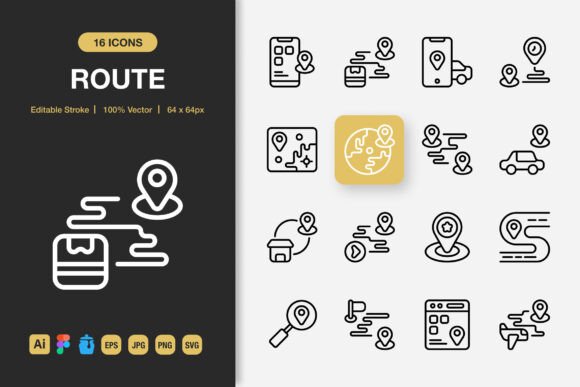
This particular set of route outline icons arrives as a collection built for versatility. Designers, developers, content creators, and small business owners can drop them into digital or print projects without wrestling with compatibility issues. But beyond the technical specs, the real value lies in how these symbols behave in context. A well-placed compass glyph on a hiking trail app, a clean airplane icon on a travel booking mobile interface, or a subtle map pin on a café's printed flyer—each one tells part of a story without adding visual weight.
Where Route Outline Icons Actually Show Up
Think about the last time you opened a rideshare app. You probably didn't consciously notice the tiny car icon, the dotted route line, or the destination flag. But if any of those were missing or styled inconsistently, your brain would register the friction. That's the quiet job of route outline icons. They live on mobile apps, yes, but also in infographics that explain logistics workflows, in social media posts promoting a new bike trail, in classroom presentations about urban planning, and in print brochures for tourist attractions.
A blogger mapping out a road trip itinerary might use these icons to break up dense text, giving readers a quick visual anchor for each stop. An entrepreneur pitching a logistics startup could weave them into a slide deck to illustrate delivery zones without commissioning custom illustrations. An educator building a geography worksheet benefits from having clean, scalable direction markers that don't distract from the learning objective. The variety of real-world touchpoints is broader than the word "route" initially suggests.
Websites and Landing Pages
Every service-based website needs to guide visitors toward action, and route outline icons can reinforce that journey visually. A tour operator might place a subtle trailhead icon next to their "View Itineraries" button. A moving company could use a truck-and-arrow symbol to anchor their quote request section. The key is choosing symbols that match the mental model your visitors already have. When someone sees a dashed line connecting two points, they instinctively understand sequence and movement, which reduces the cognitive effort required to navigate your page.
Mobile App Interfaces
Mobile screens are notoriously tight on space. Route outline icons work especially well here because they're designed to read clearly at small sizes. Think about all the moments inside a single food delivery app: the restaurant locator pin, the delivery path animation, the rider tracking marker, and the estimated time dial. Each one benefits from a consistent stroke weight and geometric clarity. Developers working with the included SVG and PNG files can scale these up or down without losing crispness, which means one download covers everything from tiny notification badges to larger onboarding illustrations.
Print Materials That Need to Work Fast
Printed flyers, event banners, and folded maps have zero interactivity, so every symbol has to earn its space. A music festival map printed on cheap paper still needs attendees to find the parking lot, the main stage, and the first-aid tent without squinting. Route outline icons with editable strokes let you adjust thickness to match your print conditions—bolder lines for offset printing on uncoated stock, finer strokes for digital print on glossy paper. Campground owners, wedding planners, and conference organizers all deal with this reality. The symbols either help people orient themselves or they become decorative clutter.
How Different People Use the Same Icon Pack
What makes a versatile set interesting is watching how it gets repurposed across entirely different contexts. A freelance graphic designer might import the Figma file and start tweaking colors to match a client's brand palette within minutes. A content marketer running a travel newsletter could pull the PNG files into Canva and build a quick featured image for the next email blast. A small business owner printing local area guides might open the EPS file in Adobe Illustrator, adjust the stroke weight, and send it straight to the print shop.
The included Iconjar file adds another layer for organized teams. When multiple designers share icon libraries across projects, having everything tagged and searchable saves hours of hunting. Instead of recreating a generic airplane or location pin from scratch, someone on the team opens Iconjar, types "route" or "destination," and grabs the approved version. Consistency across brand touchpoints becomes easier to maintain, which matters whether you're a solo creator or part of a distributed team.
Social Media Content Creators
Social feeds move fast, and visual clarity stops the scroll. A fitness coach posting a running route challenge on Instagram Stories might overlay a path icon and a finish flag to make the call-to-action instantly legible. A travel influencer recapping a multi-stop trip could use sequential markers in a carousel post, giving followers a clear sense of the journey without typing a paragraph per slide. These small design choices add up. When followers consistently recognize the symbols you use, your content starts to feel more cohesive and intentional, which builds the kind of visual trust that keeps people coming back.
Educators and Trainers
Instructional materials live or die by clarity. A driving instructor creating a handout about right-of-way scenarios needs arrows, intersection markers, and vehicle icons that don't introduce ambiguity. A corporate trainer building an onboarding deck about office logistics—where to park, how to badge in, which elevator to take—can use route symbols to map out those steps visually. The fact that these files are editable means you're not stuck with colors or stroke weights that clash with your existing formatting. Customize once, reuse across the whole course.
Realistic Workflow Considerations
Before you download and start dragging icons everywhere, it's worth asking a few practical questions. What file formats does your current project actually need? If you're working entirely in Figma, the Figma file and SVG exports will cover most of your bases. If you're sending files to a commercial printer, the EPS and JPG versions matter more. If you're building a website, optimizing PNGs with proper transparency for dark mode backgrounds should be on your checklist. The Readme file included in the download usually answers compatibility questions, so skimming it first can spare you the frustration of guessing.
Another consideration is stroke consistency. The editable stroke feature is genuinely useful, but it also requires restraint. Mixing icons with drastically different stroke weights inside the same interface or layout creates visual noise. Decide on a uniform thickness early—something that works across all the places you plan to use the icons—and apply it consistently. The 100% customizability means you have full control, which is exactly what you want when you're trying to make a set of symbols feel native to your project rather than pasted in.
Drag-and-Drop Doesn't Mean Skip the Planning
Drag-and-drop ease is a major time-saver, especially for people who aren't full-time designers. A blogger doesn't want to wrestle with pathfinder tools just to place an icon in a post. A café owner designing a simple flyer for a weekend bike ride event wants to grab a bicycle icon and a route line and be done. That convenience matters. But it's still worth spending a few minutes thinking about placement, spacing, and whether the icon actually communicates what you intend. A map pin means "location" to most people, but in certain contexts, it might read as "destination already reached" instead of "start here." Testing with one or two people before publishing catches those small disconnects early.
Where the Value Compounds Over Time
Once you have a high-quality icon set that covers route and navigation themes, you start noticing more opportunities to use it. The same path icon from a website header might later appear in a printed event program, an email newsletter, and a YouTube thumbnail. That kind of visual consistency across platforms is something big brands invest heavily in, but it's surprisingly accessible for smaller operators when the source files are organized and editable.
The inclusion of multiple file formats—Adobe Illustrator, Figma, Iconjar, EPS, SVG, PNG, and JPG—means you're not locked into a single workflow. When you switch from one project type to another, the icons come with you. A designer who primarily works in Figma this month might need to open the same assets in Illustrator next month for a packaging project. Having those options already available in the download folder removes friction at the moment you're most likely to feel it: right before a deadline.
Transparent PNG backgrounds deserve a specific mention because they solve an everyday problem. Placing a white-background icon on a colored section of a website or flyer looks amateurish. Transparent files let the background breathe through the icon, which keeps the layout looking intentional. SVG files offer the same advantage with the added benefit of infinite scalability—resize to billboard dimensions or shrink to business card proportions without pixelation.
Making the Most of a Minimalist Approach
Minimalist icon design isn't about being boring. It's about respecting the other elements on the page. When your typography, photography, or data visualization is doing the heavy lifting, your icons should step back and play a supporting role. Route outline icons handle this balance well because they're built on clean geometry rather than illustrative flourishes. A dashed route line doesn't compete with a headline. A compass rose rendered in a single stroke weight doesn't pull attention away from a photograph of a mountain range. They do their job and get out of the way.
That restraint becomes especially valuable in infographics, where multiple symbols often sit close together. Too much detail in any one icon creates an uneven visual rhythm. When every symbol shares the same design language—same stroke width, same level of geometric simplification—the infographic as a whole feels more authoritative. Readers process the information faster because they're not constantly adjusting to new visual rules with each icon they encounter.
Who Ends Up Reaching for These Icons
It's not just professional designers. Hobbyist mapmakers tinkering with fantasy world cartography use route symbols to mark trade paths and unexplored territories. Event planners drop location pins into digital save-the-date cards. Small business owners add delivery zone indicators to their website footers. Nonprofit organizers illustrating community outreach routes for volunteer coordinators. Each use case is different, but the underlying need is the same: clear, adaptable symbols that don't require a design degree to implement.
The downloadable nature of the set also means you're not reliant on an internet connection to access your assets. For freelancers working from cafes, co-working spaces with spotty Wi-Fi, or while traveling, having the files stored locally matters more than it might seem on a stable office connection. Open the folder, grab what you need, and keep working.
If you find yourself repeatedly building projects that involve directions, travel, logistics, movement, or location-based information, a focused icon set like this tends to earn its keep quickly. The time saved by dragging in a ready-made, editable symbol instead of searching through generic free icon sites—many of which have inconsistent quality and uncertain licensing—adds up across dozens of small decisions throughout a project's lifespan. Having a cohesive collection where every icon was designed to work alongside the others eliminates the patchwork look that often betrays rushed visual work.
Ultimately, route outline icons solve a specific communication problem with efficiency. They help people understand where they are, where they're going, and how to get there—whether you're designing a digital product, laying out a printed guide, or telling a visual story on social media. When the symbols are clean, consistent, and easy to adapt, the focus stays where it belongs: on the experience you're trying to create for the person on the other side of the screen or the page.